

At 3 a.m. last week, my cat Mimi knocked a full glass of water off my nightstand, looked me dead in the eye, and walked away like nothing happened. That was the fourth wake-up call in five nights, and it took me longer than I’d like to admit to realize this wasn’t spite. It was cat boredom, plain and simple, and Mimi had too little to do and far too much time to do it in.
If you’re reading this at 6 a.m. with a knocked-over plant or a cat yowling outside your bedroom door, you’re not alone, and you’re not doing anything wrong. Most indoor cats are wired to hunt, climb, and problem-solve for hours a day, and when that drive has nowhere to go, it comes out sideways. Below are the signs I’ve learned to watch for, plus what actually helped in my house.

What Cat Boredom Actually Looks Like
Cat boredom isn’t just a cat sleeping a lot. Cats sleep 12 to 16 hours a day even when they’re perfectly content. The difference is what happens in the hours they’re awake. A bored cat tends to be either destructive and demanding, or flat and withdrawn, with very little in between. Both extremes point to the same root problem: not enough mental or physical work to do.
10 Signs Your Cat Is Bored
1. Overgrooming or Bald Patches

A cat with nothing to do will often turn that energy inward. Watch for a bald strip along the belly or inner legs, or grooming sessions that go on well past a normal cleanup. This can also be a stress or medical symptom, so if you spot bald patches, a vet visit is worth ruling that out first.
2. Knocking Things Off Shelves
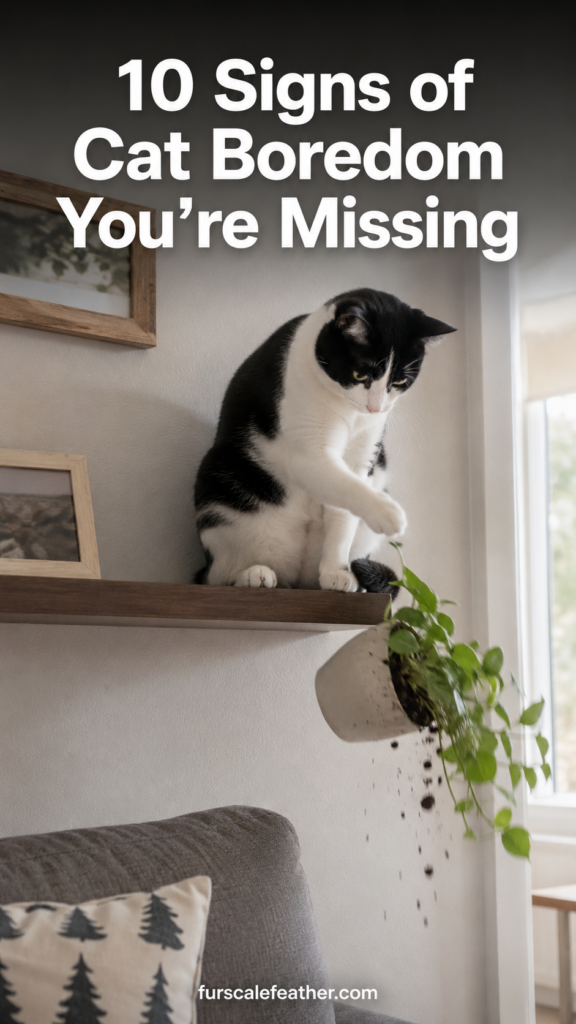
This is the one that got my attention. Mimi started sweeping pens, cups, and small plants off every flat surface in the apartment, always while making eye contact with me first. It’s a classic bored-cat move. Cats are testing cause and effect, and an object crashing to the floor is instant, reliable entertainment.
3. Meowing at Odd Hours

Excessive vocalizing, especially in the early morning or the middle of the night, is often less about hunger and more about an underused brain. Mimi’s 3 a.m. wake-up calls dropped from nightly to about twice a week once I changed her evening routine, which I’ll get to below.
4. Ambushing Your Feet or Ankles

A cat who lies in wait to pounce on ankles isn’t being mean. It’s redirected hunting behavior. Indoor cats have no mice or birds to stalk, so moving feet become the nearest available prey.
5. Excessive Sleeping With Little Activity in Between
Sleeping a lot is normal for cats, but a cat who barely stirs during the few waking hours it has, showing no interest in toys, windows, or people, may be understimulated rather than simply tired.
6. Destructive Scratching Outside the Scratching Post
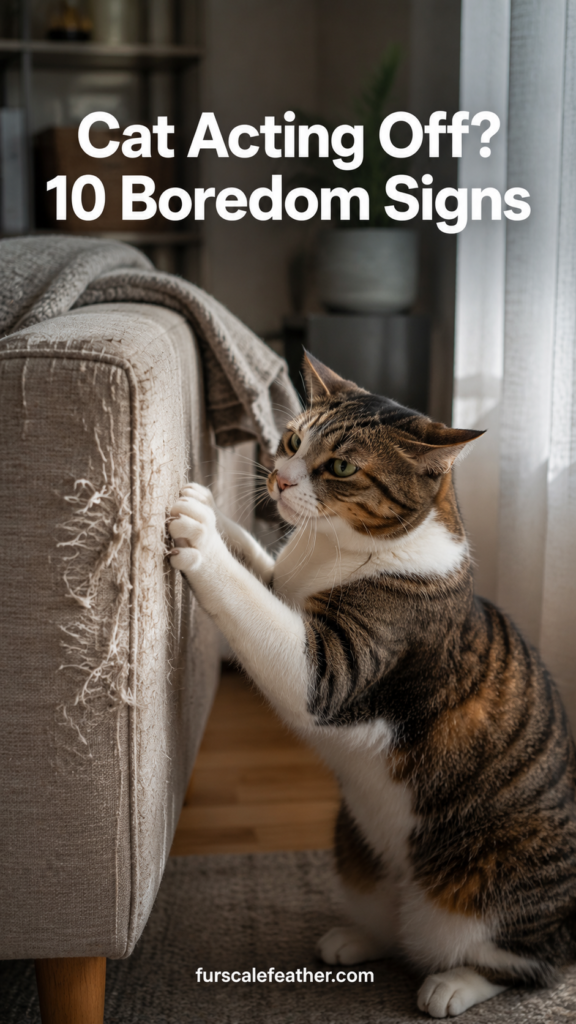
Scratching is healthy and necessary. Scratching the couch arm, the carpet edge, or the door frame instead of a designated post is usually a sign the cat needs more outlets, not fewer.
7. Pacing or Restlessness
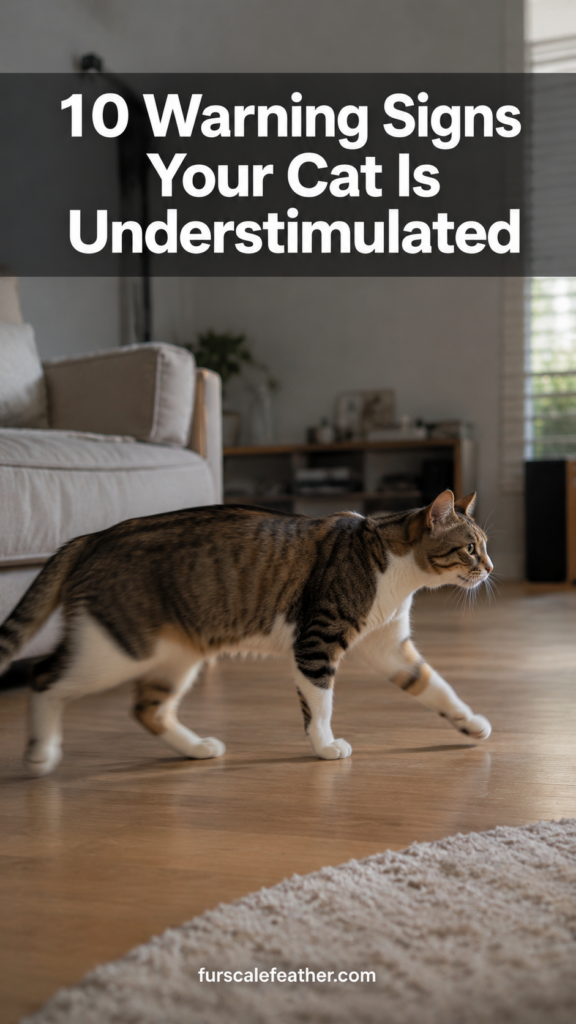
A cat that walks the same loop around the living room repeatedly, or paces at a closed door, is showing you it has energy with nowhere to put it.
8. Overeating or Begging Constantly
Food is one of the few forms of stimulation always available to an indoor cat, so a bored cat may start begging or eating past the point of hunger. If this shows up alongside weight changes, loop in your vet.
9. Loss of Interest in Toys They Used to Love

A toy that gets ignored after the first few uses is often a sign of a stale environment rather than a “bad” toy. Cats habituate to the same object fast.
10. Attention-Seeking That Escalates
Nudging, then pawing, then knocking things over, then finally sitting on your keyboard. If your cat’s attempts to get your attention keep ramping up, it usually means the earlier, quieter signals didn’t work.
How to Fix Cat Boredom: A Simple Enrichment Plan

Here’s the routine that actually moved the needle with Mimi, broken into steps you can start today.
- Add one puzzle feeder to a daily meal. Replacing even one bowl meal with a puzzle feeder gives your cat a job to do instead of a five-second gulp-and-done.
- Run two short play sessions a day. Aim for 10 to 15 minutes each, using a wand toy that mimics prey movement, darting and pausing rather than being dragged in a straight line.
- Rotate toys weekly instead of leaving them all out. Put two-thirds of the toy basket away and swap it every week. A “new” toy is really just an old toy your cat forgot about.
- Add vertical space. A window perch or a cat tree near a window gives access to both height and outside stimulation, which covers two enrichment needs at once.
- End the evening with a play-then-feed routine. A 10-minute play session followed by a small meal mimics a natural hunt-eat-groom-sleep cycle and tends to settle cats down for the night.
My own mistake here was assuming Mimi just wanted a fancier bed. I bought a plush heated bed thinking comfort was the missing piece, and she ignored it for two weeks straight. What actually worked was the toy rotation and the evening play-then-feed routine. Within about 10 days, her 3 a.m. wake-ups dropped from nightly to roughly twice a week, and the shelf-sweeping stopped almost entirely.
Best Products for a Bored Indoor Cat

I’ve personally used the first item below with Mimi. For the other two, I’m relying on a combination of veterinary-recommended enrichment guidelines and aggregated user reviews rather than my own testing, and I’m noting that clearly.
1. Trixie 5-in-1 Activity Flip Board (personally tested) Mimi took about three sessions to figure out the sliding and flipping compartments. Once she did, a full board of kibble went from a 10-second gulp to roughly 12 to 15 minutes of steady work.
- Pros: Multiple difficulty levels on one board, easy to clean, holds both wet and dry food in different compartments.
- Cons: Loud on hard floors, needs a non-slip mat underneath.
2. Cat Dancer Wand Toy (reader-reported and user-review based) This is one of the most consistently recommended wand toys across cat forums and product reviews, mainly because the rolled-paper “prey” moves unpredictably rather than in a straight line.
- Pros: Inexpensive, erratic movement holds interest longer than most feather wands.
- Cons: The paper end wears out and needs replacing every few months.
3. Frisco 74-Inch Cat Tree (user-review based) Frequently recommended in cat owner communities for combining height, scratching posts, and a window-facing perch in one piece of furniture.
- Pros: Multiple perch heights, built-in scratching posts, sturdy base.
- Cons: Large footprint, assembly takes time.
My pick: the Trixie Flip Board. For a typical indoor cat and a typical owner short on time, it’s the lowest-effort, highest-impact change, since it turns an existing meal into enrichment instead of asking you to add a new activity to your day.
Disclosure: This article may contain affiliate links. If you purchase through them, this site may earn a small commission at no extra cost to you. Product experiences noted as “reader-reported” or “user-review based” were not personally tested by me.
Questions People Usually Ask
How do I know if my cat is bored versus sick? Sudden changes like bald patches, appetite shifts, or new aggression can overlap with medical issues. If a behavior appears suddenly or comes with other symptoms, check with a veterinarian before assuming it’s boredom.
How much playtime does an indoor cat actually need? Most cats do well with two 10 to 15 minute sessions a day. Consistency tends to matter more than total time.
Can bored cats become aggressive? Yes. Redirected hunting behavior, like ankle-ambushing or sudden biting during petting, is a common outcome of an understimulated cat.
Will a second cat fix boredom? Sometimes, but not always. Two cats can play together, but they can also just as easily ignore each other or add stress if they don’t get along. Enrichment changes are worth trying first.
How long does it take to see improvement after adding enrichment? In my experience with Mimi, the clearest changes showed up within 7 to 10 days of a consistent routine. Individual cats vary.
If your cat is sweeping cups off the counter, pacing at 3 a.m., or ignoring toys they used to love, the fix usually isn’t a new gadget. It’s a more consistent routine that gives them something to work for. Start with one puzzle feeder and one daily play session, give it 10 days, and watch what changes. Most owners see a real shift before the second week is out.